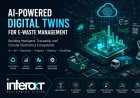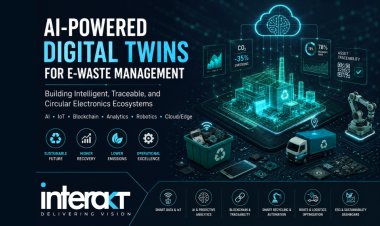
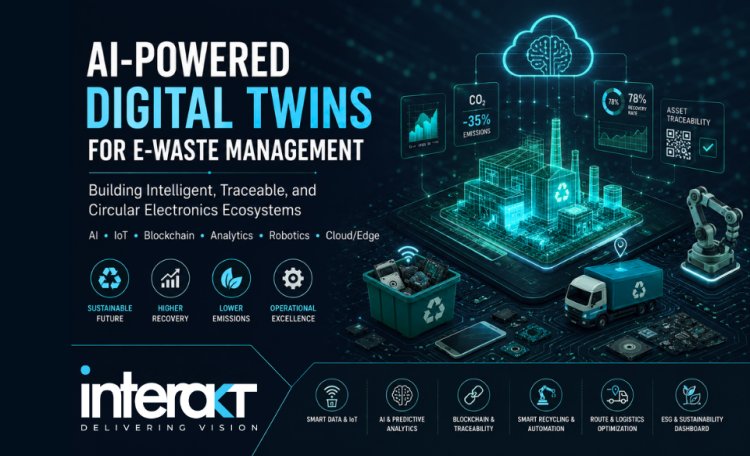
AI-Powered Digital Twins for E-Waste Management: Building Intelligent, Traceable, and Circular Electronics Ecosystems
Discover how AI-powered Digital Twins, IoT, blockchain, robotics, and predictive analytics are transforming e-waste management, resource recovery, ESG reporting, and circular economy operations.
 Hema Dubey
The world generated approximately 62 million metric tonnes of electronic waste in 2022, according to the Global E-waste Monitor. By 2030, global e-waste generation is projected to exceed 82 million metric tonnes, making it one of the fastest-growing waste streams on the planet.
Yet despite the growing volume, only around 22% of global e-waste is formally collected and recycled, leaving billions of dollars worth of recoverable materials lost every year.
The challenge extends far beyond disposal.
Every discarded smartphone, laptop, battery pack, industrial controller, medical device, server, or IoT sensor contains valuable resources, including gold, silver, copper, cobalt, lithium, palladium, and rare earth elements. At the same time, these devices often contain hazardous substances that require strict environmental and regulatory controls.
The question facing governments, recyclers, manufacturers, smart cities, and sustainability leaders is no longer:
"How do we dispose of e-waste?"
The real question is:
"How do we create a continuously connected, intelligent system that tracks, predicts, optimizes, and recovers value from electronic waste throughout its lifecycle?"
The answer increasingly lies in AI-powered Digital Twins.
What Is an AI-Powered Digital Twin for E-Waste Management?
A Digital Twin is a virtual representation of a physical asset, process, facility, or ecosystem that continuously receives real-time data from connected systems.
In e-waste management, a Digital Twin creates a living digital model of:
- Electronic assets
- Collection points
- Smart bins
- Transportation fleets
- Recycling facilities
- Material recovery operations
- ESG reporting systems
- Circular economy networks
When combined with AI, IoT, blockchain, analytics, robotics, cloud computing, and edge intelligence, the Digital Twin evolves from a monitoring tool into a decision-making platform.
Instead of simply tracking waste, organizations can simulate future scenarios, predict operational outcomes, optimize recovery rates, reduce emissions, and improve regulatory compliance.
Why Traditional E-Waste Management Is Reaching Its Limits
Many organizations still operate with fragmented systems:
- Manual inventory records
-
Siloed recycling data
-
Limited asset visibility
-
Reactive collection schedules
-
Inconsistent compliance reporting
-
Minimal material traceability
As e-waste volumes continue to rise, these limitations create significant challenges:
Rising Operational Costs
Transportation often represents one of the largest cost components in e-waste operations. Fixed collection schedules frequently result in partially filled pickups and inefficient fleet utilization.
Resource Recovery Losses
Valuable materials are often lost due to poor sorting accuracy and limited visibility into material composition.
Compliance Complexity
Regulations such as WEEE, Extended Producer Responsibility (EPR), Battery Regulations, ESG reporting frameworks, and emerging Digital Product Passport requirements demand unprecedented transparency.
Limited Predictive Capability
Most waste systems explain what happened yesterday. Few can accurately predict what will happen tomorrow.

The Technology Architecture Behind Intelligent E-Waste Digital Twins
Smart Data and IoT Infrastructure
The foundation of any Digital Twin begins with real-time data acquisition.
Connected infrastructure includes:
- Smart collection bins
-
RFID asset tracking
-
QR code identification
-
GPS-enabled transportation
-
Smart weighing systems
-
AI-powered visual inspection systems
-
Environmental sensors
These technologies create a continuous stream of operational intelligence.
Rather than relying on periodic reporting, organizations gain real-time visibility into asset movement, waste generation patterns, collection requirements, and recycling workflows.
Edge and Cloud Intelligence
Modern Digital Twins require both edge and cloud computing.
Edge systems process information close to the source, enabling:
- Real-time anomaly detection
-
Faster operational decisions
-
Reduced network latency
-
Enhanced cybersecurity
Cloud platforms provide:
- Large-scale analytics
-
Cross-site visibility
-
Predictive modeling
-
Historical trend analysis
-
Enterprise dashboards
Together, they create a scalable intelligence architecture capable of handling millions of data points daily.
AI and Predictive Analytics: The Brain of the Digital Twin
Artificial Intelligence transforms raw operational data into actionable intelligence.
Waste Generation Forecasting
Machine learning models can identify:
- Seasonal waste patterns
-
Product replacement cycles
-
Consumer disposal behaviors
-
Geographic waste concentration trends
This enables proactive planning rather than reactive response.
Collection Optimization
AI can dynamically recommend:
- Pickup schedules
-
Fleet assignments
-
Resource allocation
-
Route prioritization
Predictive Maintenance
For recycling plants and processing equipment, predictive models detect early signs of:
- Equipment wear
-
Component failures
-
Operational bottlenecks
Reducing downtime and improving productivity.
ESG and Carbon Intelligence
Organizations can quantify:
- Carbon emissions
-
Transportation impact
-
Recovery efficiency
-
Circularity performance
Providing measurable sustainability outcomes.
Smart Recycling and Robotic Automation
One of the most transformative applications of AI-powered Digital Twins is intelligent recycling.
Modern facilities increasingly deploy:
- Computer vision systems
-
Robotic sorting arms
-
AI-assisted material recognition
-
Conveyor analytics
-
Hazard detection systems
Advanced AI can identify:
- Batteries
-
Circuit boards
-
Plastics
-
Precious metal components
-
Hazardous materials
with significantly greater consistency than manual processes.
As labor shortages continue to affect recycling industries globally, automation is becoming a strategic necessity.
Blockchain and End-to-End Traceability
Traceability is rapidly becoming a competitive advantage.
Blockchain enables:
- Immutable transaction records
-
Asset lifecycle tracking
-
Material provenance verification
-
Compliance auditing
-
Digital product passports
-
Smart contract automation
The European Union's upcoming Digital Product Passport initiatives are expected to accelerate demand for transparent material tracking systems.
Digital Twins combined with blockchain create a trusted, verifiable chain of custody from collection through recovery and reuse.
Route Optimization and Logistics Intelligence
Transportation inefficiencies significantly impact profitability.
AI-driven Digital Twins continuously analyze:
- Traffic conditions
-
Collection priorities
-
Vehicle capacity
-
Fuel consumption
-
Weather patterns
Dynamic route optimization can reduce:
- Fuel costs
-
Collection times
-
Carbon emissions
while improving service reliability.
For large-scale municipal and industrial operations, even small route improvements can generate substantial annual savings.
Resource Recovery and the Circular Economy
E-waste contains an estimated tens of billions of dollars worth of recoverable materials annually.
Digital Twins enable organizations to maximize recovery of:
- Copper
-
Gold
-
Silver
-
Lithium
-
Cobalt
-
Rare earth elements
Instead of viewing electronics as waste, organizations can treat them as strategic resource reservoirs.
This transition supports the broader shift toward circular manufacturing and sustainable supply chains.
ESG Reporting and Sustainability Intelligence
Investors, regulators, and customers increasingly demand measurable sustainability performance.
Digital Twins provide real-time visibility into:
- Recovery rates
-
Carbon footprint
-
Waste diversion
-
Circularity indicators
-
Resource utilization
-
Compliance performance
This transforms ESG reporting from a periodic exercise into a continuous operational capability.
The Business Impact
Organizations implementing AI-powered Digital Twin architectures can achieve:
- Reduced collection and transportation costs
-
Higher material recovery rates
-
Improved fleet utilization
-
Enhanced compliance readiness
-
Lower carbon emissions
-
Increased operational transparency
-
Better resource efficiency
-
Stronger ESG performance
Most importantly, Digital Twins enable organizations to move from reactive waste management to predictive resource management.
How Interakt Techsol Enables Intelligent E-Waste Ecosystems
At Interakt Techsol, we believe the future of waste management lies in connected intelligence.
Our expertise across:
- Artificial Intelligence and Machine Learning
-
IoT Infrastructure Development
-
Blockchain Solutions
-
Big Data Analytics
-
Cloud Platforms
-
Mobile and Enterprise Applications
-
Logistics Optimization Systems
-
Digital Transformation Programs
enables organizations to build scalable Digital Twin ecosystems tailored to their operational requirements.
Rather than deploying isolated technologies, we focus on creating integrated systems where data, intelligence, automation, and sustainability work together.
The Future Is Not Waste Management. It Is Resource Intelligence.
By 2030, the organizations leading e-waste transformation will not be those collecting the most waste.
They will be the organizations that understand the most about it.
AI-powered Digital Twins represent the next evolution of waste management—transforming disconnected operations into intelligent, traceable, and circular ecosystems.
The future belongs to organizations that can see, predict, optimize, and recover value from every asset they manage.
Because in the digital economy, waste is no longer just waste.
It is data.
It is intelligence.
It is opportunity.
Ready to Build Smarter Circular Systems?
Interakt Techsol helps organizations design and deploy intelligent ecosystems powered by AI, IoT, blockchain, analytics, cloud platforms, and Digital Twin technologies.
FAQ
1. What is a Digital Twin in waste management?
A Digital Twin is a virtual representation of physical waste assets, processes, and infrastructure that continuously receives real-time data from IoT devices, sensors, logistics systems, and analytics platforms.
2. How does AI improve e-waste management?
AI improves forecasting, route optimization, predictive maintenance, automated sorting, material recovery, and operational decision-making.
3. Why is blockchain important for e-waste management?
Blockchain creates immutable records of asset movement, recycling processes, compliance activities, and material provenance, improving transparency and auditability.
4. What are the benefits of Digital Twins for recycling companies?
Benefits include higher recovery rates, lower operating costs, better compliance, predictive planning, enhanced traceability, and improved ESG performance.
5. How do Digital Twins support the circular economy?
Digital Twins provide visibility into product lifecycles, enabling reuse, refurbishment, recycling, and recovery of valuable materials instead of disposal.
6. Can Digital Twins reduce carbon emissions?
Yes. By optimizing collection routes, improving resource recovery, reducing landfill dependency, and supporting circular economy practices, Digital Twins can significantly lower environmental impact.