Beyond AI Adoption: Why the Future of Digital Transformation Depends on Connected Execution
Explore how Interakt Techsol connects AI, cloud, data and digital engineering to improve business execution.
 Hema Dubey
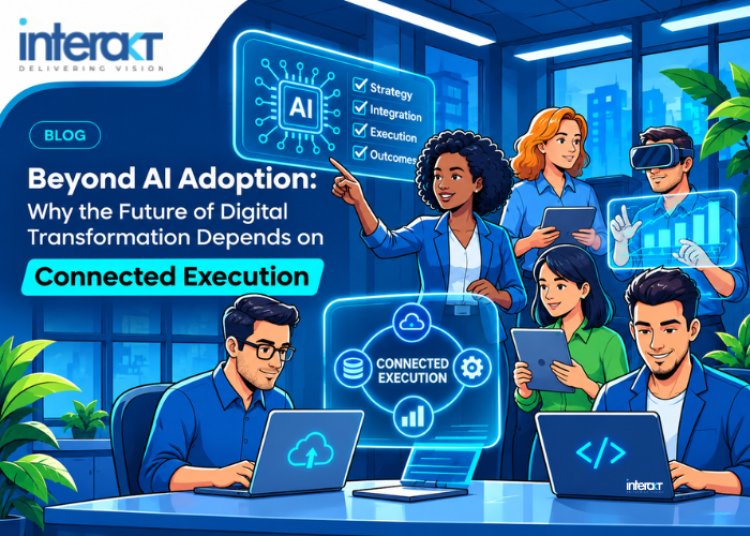
Businesses are investing in more technology than ever before.
Artificial intelligence is changing how organizations make decisions. Cloud computing is transforming enterprise infrastructure. Automation is reshaping workflows, while connected platforms and real-time data are opening new possibilities for operational efficiency and business growth.
Yet one challenge continues to hold businesses back.
Technology is advancing faster than organizations can turn it into meaningful business value.
An enterprise may have an AI strategy, a cloud modernization roadmap, multiple digital platforms, and significant investments in data infrastructure. But when these initiatives operate independently, the result is often more complexity rather than better performance.
Systems remain disconnected; data remains fragmented; applications struggle to communicate; Manual processes continue alongside new digital tools. And promising technology initiatives fail to become part of everyday business operations.
The AI era will not be defined by the number of technologies businesses adopt.
It will be defined by how effectively they connect technology, execution, and measurable business outcomes.
The AI adoption gap

The gap highlights an important consideration for business leaders.
Deploying AI is one challenge. Embedding it across business functions, connecting it with enterprise data, and establishing the governance needed to operate it reliably is another.
Organizations must move beyond experimentation toward repeatable processes, accountable ownership, and clear performance indicators.
The real challenge is no longer proving that AI can work. It is making AI work consistently within the business.
For years, digital transformation was largely measured by technology implementation.
Businesses migrated infrastructure to the cloud, digitized processes, introduced enterprise software, and developed applications to modernize operations.
These investments remain essential. But adopting new technology does not automatically create a more efficient or intelligent organization.
An AI solution cannot deliver reliable insights when the underlying data is fragmented. A cloud migration may improve infrastructure flexibility without addressing inefficient workflows. An enterprise application can introduce new capabilities while creating additional operational complexity if it cannot integrate with existing systems.
This is changing what organizations expect from technology consulting.
Business leaders increasingly need partners who can look beyond individual technologies and understand how AI, cloud infrastructure, data, applications, and enterprise systems work together.
The objective is no longer simply to modernize technology.
It is to build connected digital environments where every technology investment serves a clear business purpose.
Every industry approaches digital transformation differently.
Healthcare organizations are working toward more connected patient information and digital care workflows. Financial services companies are strengthening digital transactions and customer experiences. Logistics businesses are seeking better visibility across transportation, inventory, and delivery operations.
Meanwhile, retailers are improving digital engagement, and enterprises across industries are exploring AI and automation to make operations more responsive.
Despite these different priorities, many organizations face similar challenges.
Business-critical data is distributed across disconnected platforms. Manual processes slow down operations. Legacy systems restrict integration. And technology initiatives are often implemented without considering how they will function within the broader enterprise environment.
The challenge isn't always a lack of technology.
It's the absence of a connected approach to using it.
At Interakt Techsol, our capabilities across technology consulting, custom application development, AI/ML, cloud and big data solutions, enterprise systems, blockchain, and IoT reflect the need to address digital transformation as an interconnected business challenge.
Because meaningful transformation requires more than building individual solutions.
It requires understanding how those solutions fit together.
The questions being asked by business leaders are changing.
Instead of asking where AI can be introduced, organizations are evaluating where it can improve measurable outcomes. Cloud modernization is increasingly being considered through the lens of scalability, security, and operational resilience. Data is becoming central to business decisions, while application development is evolving toward more integrated and adaptable digital ecosystems.
These priorities are closely connected.
 Organizations cannot address these priorities effectively in isolation.
An AI strategy depends on data readiness. Cloud modernization influences application performance. Systems integration determines whether information can move across business functions. Cybersecurity and governance affect the reliability of the entire environment.
The future of technology consulting lies in connecting these disciplines into a coherent transformation approach.
One of the most significant opportunities in digital transformation lies in connecting technologies that traditionally operate independently.
Consider an organization with separate systems for customer interactions, operations, analytics, and enterprise resource planning.
Each platform may perform its intended function. But without effective integration, information must be transferred manually, workflows become fragmented, and decision-makers struggle to establish a consistent operational view.
Connecting these systems can change how the organization operates.

Cloud infrastructure provides scalable computing resources. Data management makes information more accessible. AI and analytics support intelligent processing. Enterprise applications turn insights into operational workflows. Systems integration connects the entire environment.
Together, these capabilities can create a more coordinated digital ecosystem.
The value becomes particularly visible in industries where operational activities depend on information moving between multiple systems.
For example, Interakt Techsol's work in waste management applications demonstrates how service requests, collection coordination, quotations, payments, and operational updates can be brought into connected digital workflows.
Similarly, logistics applications can integrate driver assignments, location information, delivery updates, and customer confirmations to support more coordinated operations.
These applications demonstrate an important principle.
Digital transformation creates greater value when technology simplifies the way a business operates, rather than adding another layer of complexity.
As organizations connect more applications, AI models, cloud platforms, and data sources, the potential consequences of security failures become more significant.
IBM's Cost of a Data Breach Report 2026, released in July, found that the global average cost of a data breach reached $4.99 million, a 12% increase over the previous year.

IBM also reported that organizations extensively using AI and automation in security operations experienced average breach costs $1.93 million lower than organizations using neither. This is an observed association, not proof that implementing those tools alone produces that saving.
For enterprises, these findings reinforce the need to incorporate security into the broader technology lifecycle.
AI governance, identity management, data protection, access controls, monitoring, and incident response should be considered during architecture and implementation—not added after deployment.
Secure digital transformation requires systems that are not only connected and scalable, but also governed, monitored, and resilient.
A transformation strategy can be technically sound and still struggle to deliver meaningful business value.
The difference often lies in how success is defined and measured.
Organizations need to connect technology initiatives with specific operational problems, implementation responsibilities, and measurable outcomes.
 Successful execution requires defining a performance baseline, identifying the expected improvement, and establishing how results will be measured after implementation.
That creates a clearer connection between technology investment and business performance.

This approach also recognizes that transformation is not complete when a new application goes live.
Systems need to be maintained, optimized, secured, and adapted as organizational requirements change.
The pace of technological change makes long-term planning increasingly complex.
AI capabilities will continue to evolve. Cloud environments will become more sophisticated. Enterprise applications will require additional integrations, and businesses will generate increasingly complex data.
Businesses cannot predict every technology shift.
But they can build technology environments that are easier to adapt.
That means prioritizing modular architecture, interoperability, data quality, security, maintainability, and continuous improvement.
It also means recognizing that digital transformation does not always require replacing existing systems.
Sometimes the most valuable improvements come from connecting fragmented systems, modernizing an outdated application, automating a repetitive process, or making existing information more accessible.
The objective is not to build the most technologically complex organization.
It is to build a business where technology can evolve without creating unnecessary operational complexity.
The next phase of digital transformation will not be measured by how many AI models an organization deploys, how many applications it develops, or how much infrastructure it migrates to the cloud.
It's about making every technology investment work harder for the business.
Explore our capabilities: https://www.interakttechsol.com/
Frequently asked questions
Q: What is AI-driven digital transformation?
A: AI-driven digital transformation is the integration of artificial intelligence with business processes, applications, data, and infrastructure to improve decisions, automate activities, and support measurable business objectives.
Q: Why do AI initiatives struggle to scale?
A: Common barriers include fragmented data, limited integration, unclear ownership, weak governance, unsuitable infrastructure, and difficulty connecting AI capabilities with operational workflows.
Q: What is connected digital transformation?
A: Connected digital transformation is an approach that integrates applications, data, cloud infrastructure, AI, and business processes into a coordinated technology environment rather than treating each initiative independently.
Q: How does digital engineering support AI adoption?
A: Digital engineering helps organizations develop and integrate the applications, APIs, data pipelines, and infrastructure required to incorporate AI into operational systems.
Q: How should businesses measure digital transformation ROI?
A: Organizations should establish baseline performance and track relevant indicators such as operational costs, processing time, revenue impact, customer experience, system availability, and employee productivity.